Italian Wedding Soup Recipe: Authentic with Meatballs
Few Italian-American classics carry a name more misleading than “wedding soup.” The dish has nothing to do with nuptials—its true Italian name, minestra maritata, translates to “married soup,” celebrating the harmonious pairing of meats and greens rather than any ceremonial occasion. This etymological quirk is just the first layer of a dish that Italian immigrants reshaped significantly when it crossed the Atlantic. Below, you’ll find a complete guide to the authentic Neapolitan original and the home-style American version with tender mini meatballs.
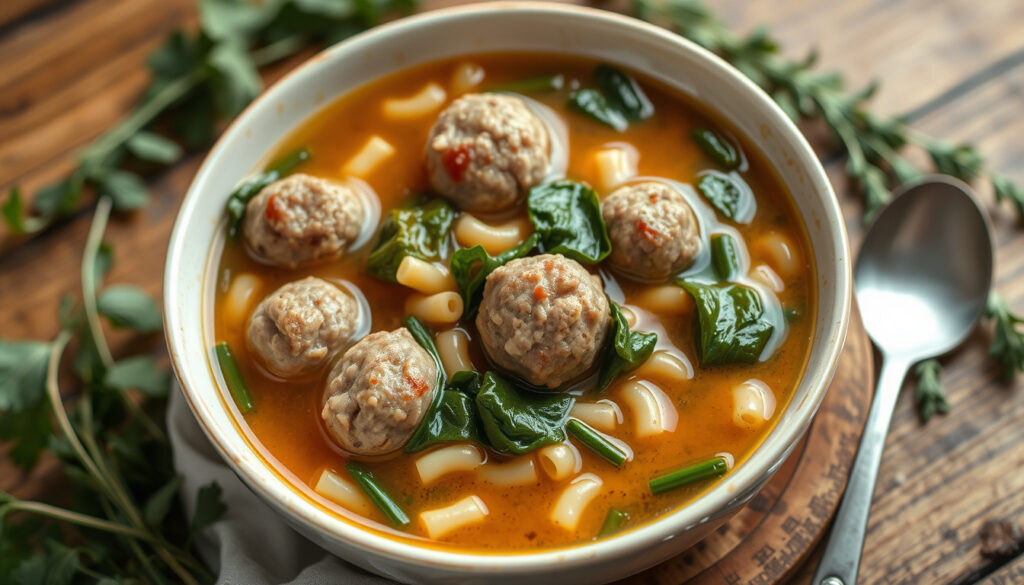
Meatballs: mini beef and pork · Pasta: tiny acini di pepe · Greens: fresh spinach · Broth: savory chicken · Prep time: 20 minutes
Quick snapshot
- Exact calorie counts without testing specific recipes
- Precise ISO dates for earliest Italian documentation
- Whether Accademia Italiana della Cucina published its documented recipes as an official report or informal blog post
- Whether the Veneto rice-based variant predates or postdates the Neapolitan pork version
- Origins in la cucina povera (pre-20th century) (Mashed)
- American meatballs added during 20th century immigration (Katie Parla)
- Step-by-step instructions for both authentic and American versions
- Regional variations you can try at home
These core facts establish the baseline for understanding how Italian wedding soup diverged from its European roots.
| Key fact | Details |
|---|---|
| Dish type | Hearty soup with meatballs |
| Key pasta | Acini di pepe |
| True origin | Minestra maritata mistranslation |
| Served at weddings | No, Italian-American creation |
| Top veggies | Spinach, carrots, celery |
What ingredients are in Italian wedding soup?
Italian wedding soup ingredients split into two distinct traditions. The authentic Neapolitan minestra maritata centers on a rich pork-based broth with seasonal greens and various cuts of meat. The American adaptation adds tender mini meatballs and small pasta, creating a lighter, more approachable soup that became standard in U.S. Italian restaurants.
Meatballs
The Italian-American version relies on small, tender meatballs made from a blend of ground beef and pork, breadcrumbs, Parmesan cheese, egg, and fresh parsley. These meatballs are typically baked at 350°F for 30 minutes before being added to the simmering broth, giving them a gentle firmness that holds up in the soup without becoming tough.
Pasta and veggies
Acini di pepe—tiny, bead-shaped pasta—absorbs the broth beautifully and adds substance without overwhelming the other components. Carrots, celery, and onion form the classic Italian soffritto base, while fresh spinach wilts directly in the pot for color and nutrients. Some variations swap spinach for escarole or kale depending on regional preference.
Broth base
Savory chicken broth serves as the foundation for the American version, simmered with aromatics until it develops depth. The broth should be flavorful enough to carry the entire soup, which means starting with a quality stock or homemade version pays dividends.
What are the little balls in Italian wedding soup called?
The little balls in Italian wedding soup are simply called meatballs—specifically, mini meatballs made from a mixture of ground beef and pork. These differ significantly from the larger meatball versions seen in other Italian-American dishes, deliberately kept bite-sized so they can be eaten in a single spoonful along with the pasta and greens.
Meatball recipe
A reliable meatball blend combines 450g of ground pork, 1/4 cup breadcrumbs, 1/4 cup grated Parmesan, one egg, and a tablespoon of minced parsley. The mixture should be gently combined—overmixing leads to dense, tough meatballs—and then rolled into 2cm spheres for even cooking.
How to form mini meatballs
Lightly dampening your hands prevents the meat from sticking while you roll. Working with about a teaspoon of mixture at a time produces uniformly sized meatballs that cook evenly. Once rolled, place them on a parchment-lined baking sheet and bake at 350°F until they’re cooked through and lightly golden, about 25-30 minutes.
Mini meatballs stay tender when you keep the fat content around 20% and bake rather than fry them. The oven method eliminates excess oil while developing a gentle crust that holds its shape in the broth.
Is Italian wedding soup a real thing in Italy?
Italian wedding soup as Americans know it does not exist in Italy. The dish Americans recognize—complete with meatballs, pasta, and greens in chicken broth—developed after Italian immigration to the United States. What does exist in Italy is minestra maritata, a completely different soup that features no meatballs and no pasta at all.
Origin and name mistranslation
The name “wedding soup” is a mistranslation of the Italian phrase minestra maritata, which actually means “married soup.” The term refers to the marriage or union of different meats and greens within the dish, not to any wedding ceremony or celebration. This naming convention reflects the Neapolitan tradition of pairing pig fat (traditionally associated with masculinity) with delicate vegetables (associated with femininity) in a harmonious broth.
Minestra maritata meaning
According to Neapolitan food writer Nello Oliviero, minestra maritata represents the “contrast of the fat of the pig with the delicacy of the vegetables.” This poetic interpretation underscores how the dish embodies opposing elements unified through cooking. Food writer Arthur Schwartz has called minestra maritata “the king of Neapolitan soups,” cementing its status as a regional treasure.
Understanding the true meaning of minestra maritata changes how you approach the dish. The authentic version is about slow-cooked, no-waste cooking using pork scraps and seasonal greens—roots in la cucina povera—rather than the premium ingredients the American version typically employs.
How to make Italian wedding soup?
Making Italian wedding soup at home follows a straightforward process: prepare the meatballs first, build the broth with aromatics and vegetables, add the pasta, and finish with wilted greens and the cooked meatballs. The entire process takes about an hour from start to finish, with most time spent letting the broth simmer and develop flavor.
Step-by-step instructions
- Preheat oven to 350°F. Combine pork, breadcrumbs, Parmesan, egg, and parsley in a bowl. Roll into 2cm meatballs and place on a baking sheet.
- Bake meatballs for 25-30 minutes until cooked through. Set aside.
- In a large pot, sauté diced onion, carrot, and celery in olive oil over medium heat until softened, about 8 minutes.
- Add chicken broth and bring to a simmer. Add acini di pepe pasta and cook for 8-9 minutes until al dente.
- Stir in fresh spinach and cook until wilted, about 2 minutes. Add the baked meatballs and heat through.
- Serve immediately with extra grated Parmesan and crusty bread.
Stove top method
The stovetop method works best when you want maximum flavor control. Starting with a quality chicken broth and building from there gives you adjustability that canned broth cannot match. Keep the heat at a gentle simmer rather than a rolling boil—aggressive boiling breaks apart the tender meatballs and overcooks the greens.
Crock pot option
A slow cooker simplifies Italian wedding soup for busy schedules. Prepare the meatballs and vegetables ahead of time, then combine everything in the Crock Pot on low heat for 4-6 hours. The extended gentle cooking develops deeper flavor integration without requiring active attention.
Easy Italian Wedding Soup with Meatballs
This easy stovetop version delivers restaurant-quality results with minimal active cooking time. The key is preparation—having your meatballs baked and greens prepped before you start the broth means the actual cooking becomes nearly hands-off.
Quick prep tips
- Make meatballs a day ahead and refrigerate—they hold well for 24 hours.
- Use pre-washed spinach to skip the prep work.
- Acini di pepe cooks quickly; add it only in the last 10 minutes to prevent mushiness.
- Grate fresh Parmesan tableside rather than pre-adding for brighter flavor.
Variations like vegetarian
Vegetarian adaptations replace the meatballs with lentil-based alternatives or simply omit them entirely for a lighter soup. The broth stays savory with extra vegetables and perhaps a Parmesan rind simmered in the pot for umami depth. Some cooks add white beans for protein and body while maintaining the vegetarian label.
Skipping the meatballs sacrifices the textural contrast that makes Italian wedding soup distinctive. If going vegetarian, compensate with toasted breadcrumbs scattered on top or a drizzle of good olive oil to add richness the meat would have provided.
Regional variations across Italy
Five regional minestra maritata recipes have been documented by the Accademia Italiana della Cucina, with four featuring meat broth and greens as the unifying thread. These regional differences reflect Italy’s culinary diversity even within a single dish concept.
Comparing regional approaches reveals how climate, local livestock, and seasonal availability shaped each tradition.
| Region | Broth base | Key ingredients | Special notes |
|---|---|---|---|
| Naples/Campania | Pork ribs, sausages, salame | Escarole, chicory | Christmas and Easter staple |
| Alto Casertano | Pig slaughter scraps | Dandelion, cardoons | Winter pig slaughter tradition |
| Veneto | Chicken stock | Rice, tagliolini pasta | Lighter, rice-based version |
| Italian-American | Chicken broth | Meatballs, acini di pepe | Added pasta and meatballs |
The implication: what Americans call “authentic” Italian wedding soup diverges significantly from any of the four documented Italian regional traditions—all of which omit both meatballs and pasta.
Steps for authentic minestra maritata
For those wanting the authentic Neapolitan experience, traditional minestra maritata requires patience but rewards with profound depth of flavor. The traditional recipe simmers pork ribs, sausages, and salame for 2.5-3 hours until the broth becomes richly meaty.
- Combine 250g pork ribs, 200g sausages, and 100g salame in a large pot with 3 liters of water. Bring to a boil, then reduce to a bare simmer.
- Simmer for 2.5-3 hours, skimming foam occasionally. The slow extraction creates a deeply flavored broth.
- Add 100g diced parmigiano-reggiano rinds and continue simmering 30 more minutes.
- Add 5 pounds of mixed greens (escarole, chicory, dandelion) and cook until tender, about 20-30 minutes.
- Finish with caciocavallo cheese cubes and serve in deep bowls with crusty bread.
Pressure cooking offers a modern shortcut: the same ingredients cook in 45 minutes under pressure while achieving comparable tenderness. This adaptation makes authentic minestra maritata feasible for weeknight cooking without sacrificing the essential character of the dish.
Upsides
- Rich, meaty broth built from pork scraps
- Uses no-waste cucina povera principles
- Seasonal greens add nutrients and color
- Authentic connection to Neapolitan tradition
Downsides
- Long simmer time (2.5-3 hours traditionally)
- Requires harder-to-find ingredients like pork rind
- No pasta or meatballs for familiar American taste
- Specialty cheese rinds may not be available
Quotes and perspectives
Minestra maritata refers to wedded broths, nuanced flavors betrothed to one another.
— Katie Parla, chef and author (Katie Parla)
The contrast of the fat of the pig with the delicacy of the vegetables.
— Nello Oliviero, Neapolitan food writer (Wikipedia)
It is the king of Neapolitan soups.
— Arthur Schwartz, food writer (Wikipedia)
These voices capture the essential tension at the heart of minestra maritata: the union of opposing elements, the marriage of fat and delicacy, the no-waste philosophy elevated to culinary art. Whether you make the American version with its comforting meatballs or the authentic Neapolitan original with its pork-forward complexity, you’re participating in a tradition spanning centuries of Italian cooking.
Related reading: Kraft Peanut Butter Cookie Recipe
memoriediangelina.com, smartchicken.com, civilwartalk.com, sandravalvassori.com, dececco.com
Frequently asked questions
What pasta is used in Italian wedding soup?
Acini di pepe is the traditional choice—tiny, bead-shaped pasta that cooks quickly and absorbs broth beautifully. Ditalini or small orzo work as substitutes if acini di pepe is unavailable.
How long does Italian wedding soup last in the fridge?
Properly stored in an airtight container, Italian wedding soup keeps for 3-4 days in the refrigerator. The pasta may absorb more broth over time, so you may need to add extra when reheating.
Can you freeze Italian wedding soup?
Yes, but freeze the broth and meatballs separately from the pasta. Pasta becomes mushy when frozen and reheated. Freeze in portions and add freshly cooked pasta when serving.
What can replace acini di pepe pasta?
Ditalini, pastina, orzo, and stelline pasta all work as substitutes. Any small pasta that cooks in 8-10 minutes will provide similar texture and won’t overwhelm the broth.
Is Italian wedding soup gluten-free?
Standard Italian wedding soup contains pasta and breadcrumbs in the meatballs, making it not gluten-free. Use rice or gluten-free pasta and substitute gluten-free breadcrumbs to adapt the recipe.
How spicy is Italian wedding soup?
Italian wedding soup is not inherently spicy. The seasoning comes from herbs like parsley and Italian seasoning. If you enjoy heat, add red pepper flakes to individual servings.
What cheese pairs with Italian wedding soup?
Grated Parmigiano-Reggiano or Pecorino Romano are traditional choices. A small amount tableside adds umami and salt balance without overwhelming the broth.
Home cooks who understand this distinction between the authentic Neapolitan minestra maritata and the Americanized wedding soup can choose which tradition to honor at their own tables—trading either the three-hour pork broth and greens of Naples for the quicker chicken broth and meatball version familiar from U.S. restaurants, or vice versa.
More related posts
 TMU Medical School Requirements 2026: GPA, MCAT, and Application Guide
 Kristen Bell: Diagnosis, Net Worth, Family & Surgery Rumors
 The Fate of Ophelia: Swift’s Song Meaning & Shakespeare
 Freida McFadden Books: Complete Reading Order Guide
 189 USD to CAD: Current Rate, Trends & Forecast 2025
 Canada Post Strike Update Today: Latest News & Impacts
 Katharine McPhee: Tragedy, Age Gap, Family & Career in 2025
 Heath Ledger’s Death: Cause, Last Words, and Legacy
