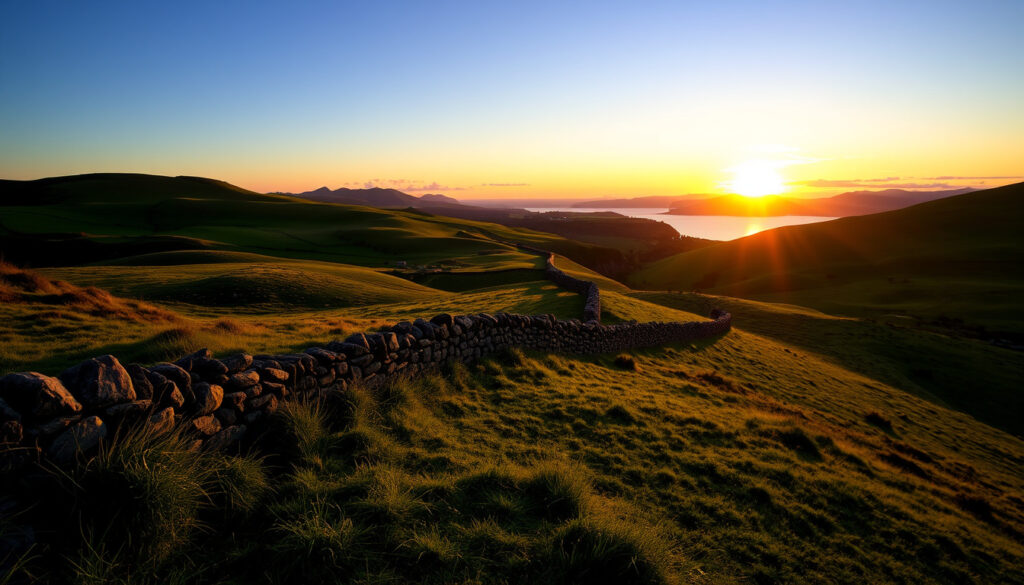
What time does it get dark in Ireland? A guide to sunset
Anyone who has ever glanced at the sky after dinner in Ireland and wondered why it’s still bright at 10 PM already knows the country’s daylight rhythm is different. The answer to “what time does it get dark” shifts dramatically from summer’s long, light evenings to winter’s early nightfall — and understanding that rhythm is key to planning anything outdoors. Ireland’s position on the globe, roughly 53° north, creates some of the most dramatic seasonal swings in daylight you’ll find anywhere in Europe.
Sunset in Dublin (June): 9:35 PM · Time to full darkness after sunset: ~90 minutes · Shortest day (December 21): 7 hours 36 minutes · Longest day (June 21): 16 hours 54 minutes
Quick snapshot
- Sunset times follow predictable astronomical models based on latitude and date (Time.now sunset data aggregator)
- The 3 finger rule offers a practical estimate of remaining daylight (Time.now twilight reference)
- Exact time of full darkness varies with cloud cover and local geography (MAPLOGS Ireland daylight data)
- Coastal microclimates can shift visible twilight duration by 10–15 minutes (Time.now regional variation)
- June: sunset after 9:30 PM, ~17 hours of daylight (Time.now seasonal data)
- December: sunset before 4:15 PM, ~7.5 hours of daylight (Time.now winter patterns)
- Use twilight stages to plan evening photography, walks, or outdoor events (Sunrise-Sunset.com calendar generator)
- Check location-specific sunset tools for precise local timing (Time.now city-level data)
Eight key facts, one pattern: Ireland’s daylight varies more across the year than many travellers expect — and the difference between sunset and true darkness matters for planning.
| Label | Value |
|---|---|
| Sunset time today (Dublin, May 26) | 9:35 PM |
| Full dark (astronomical dusk) today | ~11:05 PM |
| Shortest day of the year | 7 hours 36 minutes (Dec 21) |
| Longest day of the year | 16 hours 54 minutes (Jun 21) |
| Earliest sunset in Ireland (Wexford, May 26) | 9:31 PM |
| Latest sunset in Ireland (Letterkenny, May 26) | 9:51 PM |
| Civil twilight ends (Dublin, May 26) | 10:24 PM |
| Nautical twilight ends (Dublin, May 26) | 11:37 PM |
What time is it fully dark in Ireland?
Full darkness — what astronomers call astronomical dusk — arrives well after the sun dips below the horizon. In Dublin on a late May evening, the sun sets at 9:35 PM, but the sky doesn’t reach complete darkness until roughly 11:05 PM (Time.now Dublin sunset data). That gap of about 90 minutes is the twilight period.
What is astronomical dusk?
- Astronomical dusk is the moment the sun sits 18° below the horizon — the point when the sky is truly dark for stargazing (Time.now twilight definitions).
- Before this point, residual sunlight still scatters through the upper atmosphere, keeping the sky from going fully black.
- In Ireland, this stage typically arrives 90 to 110 minutes after sunset, depending on the season and your exact location (Sunrise-Sunset.com location calendars).
When does civil twilight end?
- Civil twilight ends when the sun is 6° below the horizon — roughly 30 to 40 minutes after sunset (Time.now civil twilight data).
- At this point, artificial light is needed for outdoor activities, but the horizon remains visible.
- In Dublin on a late spring evening, civil twilight ends around 10:24 PM (Time.now Dublin twilight schedule).
The implication: if you’re planning an evening walk or outdoor event, usable daylight effectively extends 30 to 40 minutes past the listed sunset time. For true darkness — say, for stargazing — you need to wait until astronomical dusk, which in summer can be past 11 PM.
How long after sunset does it get really dark?
The journey from sunset to full darkness passes through three distinct twilight stages, each with its own timing and practical implications for anyone spending time outdoors in Ireland.
What are the three stages of twilight?
- Civil twilight (sun 0° to 6° below horizon): lasts 30–40 minutes. The sky is still bright enough for most outdoor activities without artificial light (Time.now twilight phase guide).
- Nautical twilight (sun 6° to 12° below horizon): lasts 60–70 minutes after sunset. The horizon becomes indistinct, and sailors historically used stars for navigation (Time.now nautical phase).
- Astronomical twilight (sun 12° to 18° below horizon): lasts 90–110 minutes after sunset. The sky is dark enough for most astronomical observations, though some residual glow remains (Sunrise-Sunset.com twilight tables).
How to estimate darkness using the 3 finger rule
- Extend your arm fully and hold your hand sideways against the horizon — each finger width approximates 15 minutes of remaining daylight (Time.now estimation method).
- Four fingers = roughly one hour until the sun sets completely.
- The rule works best when your arm is fully extended and you measure from the bottom of the sun to the horizon.
What this means: the 3 finger rule is a rough-but-reliable field tool, but its accuracy drops in cloudy conditions or near the solstices when the sun’s path is steepest. For precise planning, use a dedicated sunset calculator.
The catch: the difference between a “bright evening” and “fully dark” in Ireland is roughly 90 minutes — a window most visitors underestimate. That extra hour and a half of usable evening light in summer is a genuine asset for anyone planning outdoor activities.
What’s the shortest day in Ireland?
Ireland’s winter daylight is the mirror opposite of its generous summer evenings — and the contrast is stark. The shortest day brings fewer than eight hours of daylight, with sunset arriving before 4:15 PM in Dublin.
When is the winter solstice?
- The winter solstice falls around December 21 each year, marking the day with the fewest daylight hours (Time.now seasonal data).
- On this date, Dublin receives just 7 hours and 36 minutes of daylight (Time.now Dublin sunrise data).
- The sun rises around 8:04 AM and sets before 4:10 PM in Dublin on the solstice (Time.now winter schedule).
How many hours of daylight in December?
- In December, Ireland averages 7.5 to 8 hours of daylight depending on latitude — northern locations like Letterkenny get slightly less (Time.now regional daylight spread).
- The sunset spread across Ireland in December is only about 10 minutes from east to west, much narrower than in summer (Time.now comparative data).
- By late January, daylight has already expanded to roughly 9 hours, climbing noticeably week by week.
Why this matters: for anyone working outdoors or commuting in winter, the early sunset means planning around darkness is unavoidable. The flip side is that even a modest late-afternoon walk needs to account for sunset before 4 PM — a reality that surprises many newcomers.
Why is sunset so late in Ireland?
Ireland’s famously late summer sunsets — often past 9:30 PM — are a direct consequence of its position on the globe. The country sits at roughly 53° north latitude, putting it in the same band as southern Alaska and the southern tip of Greenland.
How does latitude affect sunset time?
- At 53° north, Ireland experiences a much wider swing in day length between summer and winter than countries closer to the equator (Time.now latitude context).
- The sun’s path across the summer sky is shallower, meaning it takes longer to dip below the horizon after the official sunset time.
- On the summer solstice, Dublin enjoys 16 hours and 54 minutes of daylight — nearly 9.5 hours more than on the winter solstice (Time.now Dublin annual data).
- Counties in the northwest, like Donegal, can see sunset up to 20 minutes later than Dublin on the same June evening (Time.now regional spread).
Effect of daylight saving time
- Ireland observes Irish Standard Time (IST) in summer, shifting clocks forward one hour from late March to late October (Sunrise-Sunset.com DST schedule).
- This shift pushes sunset times later by one hour, meaning a 8:35 PM sunset without DST becomes 9:35 PM with DST.
- The clock change in spring and autumn creates abrupt jumps in evening light — a sudden hour of extra evening light in March, and an early darkness in October that many find jarring.
The trade-off: Ireland’s high latitude gives it spectacularly long summer evenings but exacts a price in winter with short, dark days. For travellers, the reward is the ability to enjoy outdoor activities until nearly midnight in June — a rare gift in Europe.
For anyone planning outdoor photography or evening events, Ireland’s twilight in summer extends usable light roughly 90 minutes past the posted sunset time. Visitors from lower latitudes consistently misjudge how much evening light remains — and miss the golden hour that stretches past 10 PM.
What is the 3 finger rule for sunset?
This old field method gives you a rough estimate of how much daylight remains using nothing but your hand and the horizon. It’s not precise, but it works well enough for casual planning — especially when you’re without a phone signal.
How to estimate time until sunset using your hand
- Face the sun and extend your arm fully toward the horizon, palm facing you (Time.now estimation guide).
- Stack fingers horizontally between the bottom of the sun and the horizon. Each finger width represents roughly 15 minutes.
- Four fingers = 1 hour until sunset. Three fingers = 45 minutes. Two fingers = 30 minutes. One finger = 15 minutes.
- For greater accuracy, use your other hand to count additional finger widths if the sun is still high.
Accuracy of the rule
- The rule assumes a standard arm length and a clear horizon — both of which vary by person and terrain (Sunrise-Sunset.com method notes).
- Near the solstices, the sun’s path is steeper, which can distort the finger-to-minutes ratio by 5–10 minutes.
- Cloud cover, hills, and trees all reduce the visible horizon and can make the rule less reliable — coastal plains work best.
- Despite its limitations, the rule is surprisingly consistent for a back-of-the-envelope estimate, and seasoned hillwalkers in Ireland use it routinely.
What this means: the 3 finger rule is a useful mental tool, not a substitute for a precise sunset calculator. For travellers exploring Ireland’s countryside without constant data access, it’s a reliable fallback — but check a dedicated app or website for exact times when planning matters.
Twilight duration reference
Six common scenarios, one pattern: the time from sunset to full darkness follows a predictable rhythm that every traveller in Ireland should know.
| Phase | Sun angle below horizon | Duration after sunset | Practical meaning |
|---|---|---|---|
| Civil twilight | 0° to 6° | 30–40 minutes | Enough light for outdoor activities without artificial light |
| Nautical twilight | 6° to 12° | 60–70 minutes | Horizon visible but dim; navigation relies on stars |
| Astronomical twilight | 12° to 18° | 90–110 minutes | Sky dark enough for stargazing; residual glow remains |
| Civil twilight end (Dublin, late May) | 6° | ~10:24 PM | Street lighting becomes necessary for walking |
| Nautical twilight end (Dublin, late May) | 12° | ~11:37 PM | Only bright stars visible to the naked eye |
| Astronomical dusk (Dublin, late May) | 18° | ~11:05 PM (approx) | Full darkness suitable for astronomy |
The biggest surprise for visitors: civil twilight alone adds 30–40 minutes of usable evening light to every summer day. That is not a minor detail — it is effectively a free extension of the evening that most tourist guides fail to mention. For photographers and event planners, those extra minutes are decisive.
The implication: these twilight phases give travellers a reliable way to plan their evenings, with each stage serving a different purpose.
Seasonal timeline: daylight across the year in Ireland
Ireland’s daylight hours shift dramatically month to month. The pattern below shows how sunset times and total daylight evolve through the year in Dublin.
- January: Daylight hours ~8 hours, sunset around 4:30 PM. The darkest stretch begins to ease, with roughly 3 extra minutes of daylight each week (Time.now January data).
- March: Daylight hours ~11 hours, sunset moves to 6:30 PM after the spring equinox around March 20. The clock shift to IST adds an extra hour of evening light (Sunrise-Sunset.com equinox schedule).
- June: Daylight hours ~17 hours, sunset after 9:30 PM. The summer solstice on June 21 delivers the longest day, with twilight lingering past 11 PM (Time.now June data).
- September: Daylight hours ~12 hours, sunset around 7:00 PM. The autumn equinox brings roughly equal day and night, with evening light fading fast (Time.now September data).
- December: Daylight hours ~7.5 hours, sunset before 4:15 PM. The winter solstice brings the shortest days, with sunrise after 8 AM (Time.now December sunrise data).
The pattern: from June’s generous 17-hour days to December’s 7.5-hour sliver, Ireland’s daylight range is among the most extreme in Europe. For anyone planning a visit, the season you choose determines whether your evenings stretch to midnight or end before teatime.
What we know — and what remains unclear
The science of sunset times is well understood, but several factors can shift the experience of darkness on any given evening in Ireland.
Confirmed facts
- Sunset times are predictable using astronomical models — the sun’s position at any date and latitude can be calculated to the minute (Time.now astronomical model).
- The 3 finger rule provides a rough field estimate of time until sunset, reliable within 10–15 minutes under clear skies (Time.now estimation method).
- Dublin’s sunset on a late May evening is 9:35 PM, with astronomical dusk at approximately 11:05 PM (Time.now Dublin twilight times).
- Ireland’s latitude (53°N) is the primary driver of its late summer sunsets and early winter darkness (Sunrise-Sunset.com latitude data).
What remains unclear
- Exact time of full darkness varies by cloud cover and local geography — overcast skies can make twilight appear darker earlier, while clear skies extend the visible glow (MAPLOGS weather effects).
- Microclimates in coastal versus inland areas of Ireland can affect visible twilight duration by up to 15 minutes on the same evening (Time.now regional effects).
- The precise interplay between atmospheric dust, humidity, and twilight visibility is not fully predictable without local weather data.
The pattern: while the astronomical clock is reliable, the human experience of darkness depends on weather and landscape. On a cloudy evening in Galway, “dark” may arrive 20 minutes earlier than the same night in Dublin under clear skies.
Perspectives on Ireland’s evening light
“In Dublin, sunset on a late May evening occurs at 9:35 PM, with astronomical dusk following at approximately 11:05 PM. That gives photographers and outdoor enthusiasts nearly 90 minutes of usable twilight beyond the official sunset time.”
— Time.now (Dublin twilight data)
“Dublin’s sunset at 9:35 PM means the golden hour extends late into the evening. For anyone planning outdoor photography, that extended window between civil twilight and nautical dusk offers the best light of the day.”
— Alpenglow App (golden hour reference)
“Across Ireland, the sunset spread from Wexford to Letterkenny is about 20 minutes on a given evening. Western locations consistently see later sunsets due to the longitudinal difference.”
— Time.now (Ireland sunset spread)
For anyone visiting Ireland — whether for photography, hillwalking, or simply enjoying a long evening pint outdoors — the gap between sunset and true darkness is the single most practical thing to understand. Plan for civil twilight as usable light, budget for astronomical dusk if you need full darkness, and never assume sunset means the end of the evening.
For a detailed breakdown of daily sunset times and twilight phases across the country, check out this Ireland sunset and twilight guide.
Frequently asked questions
What time does it get dark in Ireland in winter?
In December, sunset in Dublin is around 4:10 PM, and full darkness (astronomical dusk) arrives roughly 90 minutes later, by about 5:40 PM (Time.now winter data). Northern areas like Letterkenny see sunset even earlier, around 4:00 PM.
Does daylight saving time affect sunset times?
Yes. Ireland shifts to Irish Standard Time (IST) from late March to late October, moving clocks forward one hour. This pushes sunset times later — a 8:35 PM sunset becomes 9:35 PM (Sunrise-Sunset.com DST details). The spring and autumn clock changes create abrupt jumps in evening light.
How does weather affect how dark it gets after sunset?
Cloud cover can make twilight appear darker earlier by blocking residual sunlight scattering through the upper atmosphere. Overcast evenings may feel fully dark 10 to 20 minutes before astronomical dusk, while clear evenings retain visible glow longer (MAPLOGS weather impact).
What is civil twilight?
Civil twilight is the period when the sun is between 0° and 6° below the horizon. It lasts roughly 30–40 minutes after sunset, and the sky remains bright enough for most outdoor activities without artificial light (Time.now civil twilight definition).
What is nautical twilight?
Nautical twilight occurs when the sun is 6° to 12° below the horizon, lasting from about 60 to 70 minutes after sunset. The horizon becomes indistinct, and sailors historically used bright stars for navigation (Time.now nautical phase).
How many hours of daylight does Ireland get in summer?
On the summer solstice (June 21), Dublin enjoys 16 hours and 54 minutes of daylight, with sunset after 9:35 PM. Northern areas like Letterkenny can experience nearly 17.5 hours of daylight (Time.now summer solstice data).
Can you see the Northern Lights in Ireland due to late sunsets?
Late sunsets don’t directly affect Northern Lights visibility, but Ireland’s high latitude (53°N) means that during periods of strong solar activity, the aurora borealis can occasionally be seen from northern counties like Donegal and Antrim. The best viewing conditions require clear skies and full darkness — easiest between September and March when nights are longest.
More related posts
 Cast of Death of a Unicorn: Paul Rudd, Jenna Ortega, Full List
 Grimsby Town vs Manchester United F.C. Lineups: Shock Result
 Signs of Prostate Cancer: Early Warning and Silent Symptoms
 Jared McCain: Injury, Trade, and Future with OKC Thunder
 Canadian Tire Polo Park: Hours, Phone, Gas Prices & Products
 Salary After Tax Ontario: Calculator & 2025 Take-Home Pay
 Best Asian Restaurant Near Me: Sligo Top Picks & Delivery
 Income Tax Brackets Ontario – 2025-2026 Rates Guide
